
Intelligent Agents for Business: Useful or Not?
An intelligent agent for business automates, coordinates and assists your teams. Here is where it creates real gains and where caution is needed.
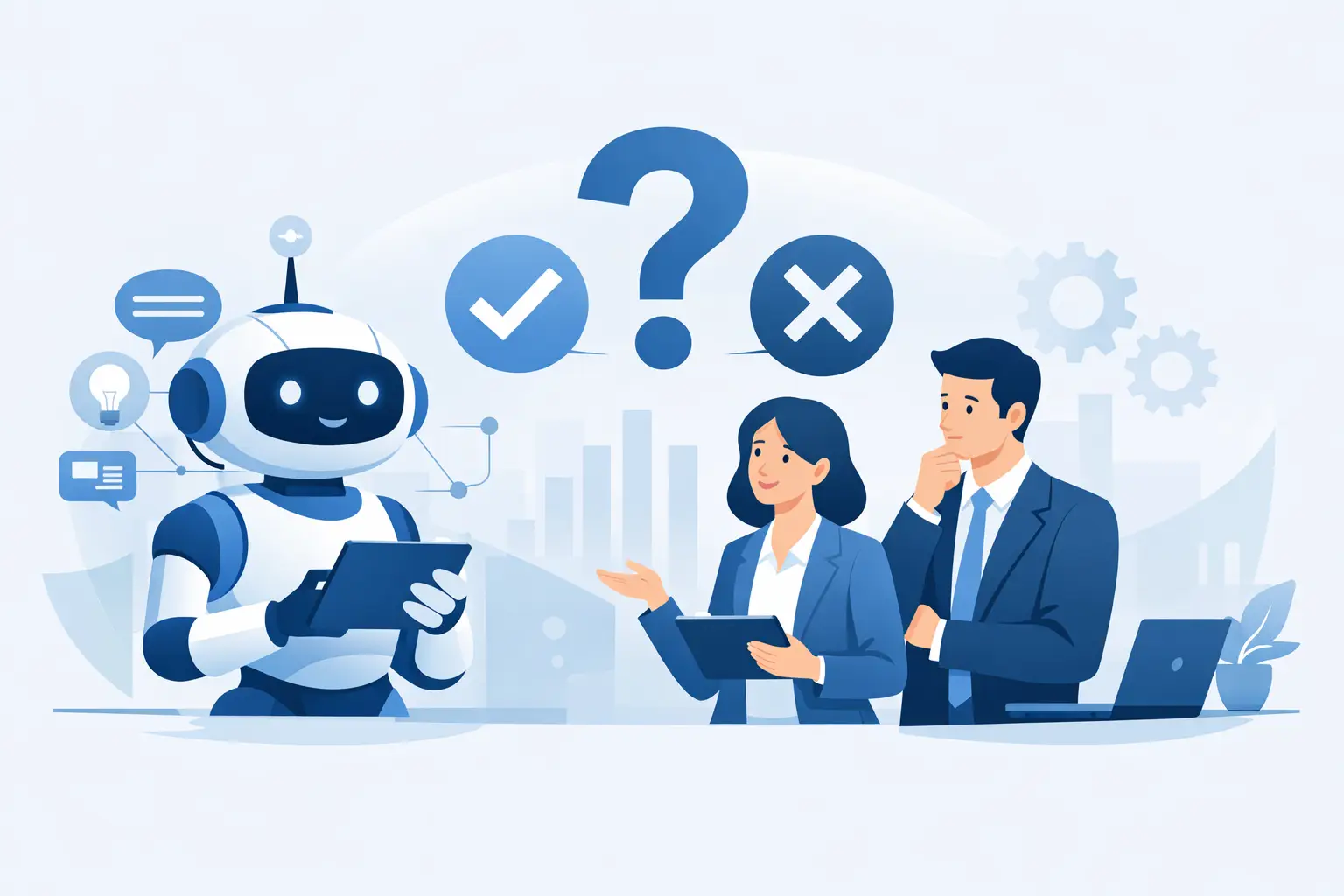
An intelligent agent for business is not just another gadget in your technology stack. It is often the missing piece when your employees juggle email, CRM, invoicing, spreadsheets and customer follow-ups with no real continuity between tools. When growth arrives, it isn’t always sales that get stuck—it’s internal friction, processing delays and decisions made with only partial visibility.
For an SME, then, the real question is not “should we do AI?” The better question is this: where can an intelligent agent lighten the load, reduce errors and improve the pace without forcing a major technology overhaul? That is where the topic becomes concrete.
What Is an Intelligent Agent for Business?
In practice, an intelligent agent for business is a system capable of carrying out a sequence of actions with a certain degree of autonomy. It doesn’t just answer a question like a simple chat assistant. It can read a request, understand the context, retrieve information from your systems, apply rules, propose an action or carry it out, then document everything.
Take a simple example. A customer sends an email asking about the status of their order. An intelligent agent can recognize the request, check the management system, confirm the status, draft a reply that matches your tone, then add a note to the file. In another context, it can qualify leads, automatically follow up on quotes, extract data from invoices or prepare a management dashboard.
The difference from conventional automation is significant. Traditional automation follows a very fixed path. If the request falls outside the planned scenario, it breaks. An intelligent agent handles variability better. It adapts to less structured inputs, such as customer messages, documents or internal requests written in natural language.
Where the Impact Is Real in an SME
Business leaders often hear big promises about AI. Yet the value rarely lies in spectacular demos. It is found in day-to-day operations.
Customer Service and Administrative Follow-Up
In many businesses, a large share of time goes to repetitive tasks: answering frequently asked questions, finding information, updating files or passing requests from one department to another. An agent can handle the first level of triage, suggest responses, trigger actions and route more sensitive cases to the right employee.
The gain isn’t just in hours saved. It is also measured in response speed, service consistency and fewer oversights.
Sales and Prospecting
Sales teams often lose time qualifying leads too early or following up irregularly. An agent can centralize incoming requests, enrich records, prioritize opportunities and suggest the next best action. It can also prepare personalized follow-ups based on previous exchanges.
This doesn’t replace the salesperson’s role. Above all, it keeps opportunities from going cold between two urgent tasks.
Finance, Invoicing and Internal Coordination
When data lives in several systems, errors multiply. An intelligent agent can check for discrepancies, extract information from invoices, spot anomalies or alert a manager to a late payment. It can also trigger internal reminders, create tasks and move information around faster.
In an SME, this fluidity matters a great deal. A few minutes saved on a hundred micro-processes end up weighing heavily on the margin.
The Conditions for an Intelligent Agent to Really Work
The potential is real, but it depends on three factors that many organizations underestimate.
1. The Quality of Your Processes
If your own team doesn’t always know how a task should be carried out, the agent won’t magically clear up that ambiguity. It can speed up a solid process. It can also amplify a poorly defined one. Before automating, you need to clarify the steps, exceptions, business rules and decision points.
2. Access to the Right Data
An agent becomes useful when it can work with the relevant information. If the data is scattered, incomplete or contradictory, its answers will be shaky. That isn’t necessarily a reason to postpone the project. Rather, it is a signal to prioritize use cases where the sources are already reliable enough.
3. Integration with Your Current Tools
Most SMEs have neither the time nor the desire to replace their entire technology environment. That is why the most effective approach is often to connect the agent to what already exists: CRM, ERP, accounting software, email, customer portal, management tools or document repositories.
That is often where results come faster. Less friction, less heavy training, more adoption.
The Limits of an Intelligent Agent for Business
A good AI project also starts with an honest look at the limits.
First, not every process warrants an intelligent agent. If a task is rare, simple and inexpensive, automating it can cost more than leaving it manual. Second, an agent is not a guarantee of absolute quality. It can misinterpret a request, lack context or generate an action that requires human validation.
There is also a governance issue. Who approves the responses? What data can the agent access? How far can it act without supervision? In industries where errors have financial, legal or reputational consequences, these questions must be settled before deployment.
In other words, autonomy should be gradual. You often start in an assisted mode, then increase the level of action once reliability is confirmed.
How to Choose a Good First Use Case
The best starting point isn’t always the most ambitious. It is the one that combines volume, repetition and measurable impact.
A good use case generally has four characteristics. It recurs often, it ties up skilled employees on low-value tasks, it relies on data that is already available and it produces a result that can be measured quickly. For example: response time, conversion rate, error reduction, processing time or a decrease in overdue accounts.
Conversely, it is better to avoid starting with a process full of exceptions, politically sensitive or dependent on chaotic data. Yes, AI can help in these contexts, but rarely as a first project.
What Leaders Should Ask Before Moving Forward
A serious vendor should not sell an intelligent agent as a one-size-fits-all solution. They should be able to explain exactly what the agent will do, which data sources it will use, how its actions will be controlled and which indicators will be used to evaluate success.
Also ask what happens when the agent gets it wrong. Can a person easily take back control? Are decisions traced? Can the rules be adjusted without starting over? These are practical questions, but they often separate useful projects from disappointing ones.
For Quebec SMEs, this pragmatic approach is often the most profitable. It is not about chasing the latest trend, but about synchronizing AI with operational reality. That is what makes the difference between an interesting proof of concept and a lasting improvement in performance.
The Intelligent Agent as a Lever for Coordination
People often talk about automation, but the most underestimated contribution of an intelligent agent is coordination. Many businesses don’t lack effort. They lack continuity between actions. A request comes in, one employee partially handles it, another waits for information, a customer follows up, and the manager ends up stepping in to pick up the pieces.
A well-integrated agent reduces this fragmentation. It follows the thread across systems, triggers the next steps and keeps a usable record. That changes the quality of execution, not just the speed.
This is also where a firm like Synchro IA can create value: not by adding yet another technology layer, but by plugging intelligence in at the right place to produce a tangible effect on operations.
An intelligent agent for business becomes truly worthwhile when it cuts the noise, provides more visibility and lets your teams focus on what no system will do for them: judge, decide, negotiate and build the customer relationship.
What about your business?
Your game plan starts with an audit: an analysis of your real operations, a quantified report and a prioritized plan. The introductory meeting is free.